
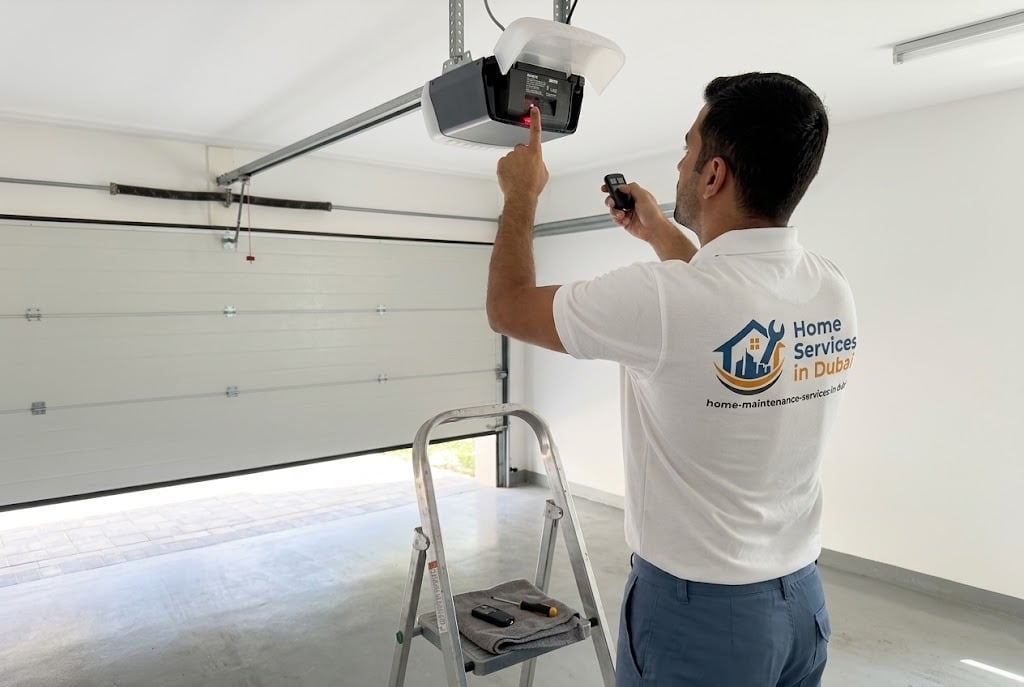
Lost a remote? Just moved in? Garage door stopped responding? Learning how to program a garage door opener takes a few minutes once you know where to look. This guide covers how a garage door opener works, how to program the remote, how to set up a keypad, and the problems that come up most.
In This Guide
- ▶ How a Garage Door Opener Works
- ▶ How to Program a Garage Door Remote
- ▶ How to Program a Garage Door Keypad
- ▶ Common Garage Door Opener Problems
- ▶ Why Heat and Dust Affect Garage Door Sensors
- ▶ When to Call a Professional
- ▶ Frequently Asked Questions
How a Garage Door Opener Works
A garage door opener runs on a motor mounted to the ceiling. The motor moves a trolley along a rail, connected to the door by a chain or belt. You control it with a remote, a wall panel, or a keypad.
Press the remote, and it sends a radio frequency signal to a receiver inside the motor unit. The receiver recognizes the signal. The motor moves the door. That’s the whole system. Programming just means teaching the receiver to recognize a new remote or keypad code.
How to Program a Garage Door Remote
Most garage door openers follow the same basic process, no matter the brand.
Step 1: Find the learn button. Usually on the back or side of the motor unit. Sometimes hidden under the light lens. Small. Often red, orange, yellow, or purple. Grab a stepladder if you need one.
Step 2: Press and release it. A light near the button starts flashing. You’ve got about 30 seconds before it times out.
Step 3: Press the remote button. Within that window, press and hold the button on the remote you want to program. Point it at the motor unit.
Step 4: Wait for the confirmation. The light stops flashing, or you hear a click. That’s the pairing done.
Step 5: Test it. Press the remote. The door should move. If it doesn’t, start again from step one.
Got more than one remote, or a car with a built-in garage button? Repeat the same steps for each one.
How to Program a Garage Door Keypad
A wireless keypad works the same way as a remote. A code instead of a button, that’s the only real difference. Press the learn button on the motor unit until the light flashes. Enter a 4-digit code on the keypad. Press enter. The code gets stored the same way a remote’s signal does.
If you like the idea of code based entry, the same logic applies to your front door. A smart door lock works on a similar principle, letting you open your door with a code or your phone instead of a key.
Common Garage Door Opener Problems
Remote not responding. Usually dead batteries. Swap them before assuming the remote’s broken.
Door opens partway, then stops. Often a sensor issue. Most openers have safety sensors near the floor on both sides of the door. If something blocks the beam, the door stops.
Motor runs, door doesn’t move. That’s usually the trolley or the chain and belt connecting the motor to the door. Not the remote. Not the programming.
Remote worked fine, then stopped. Check if the power went out recently. Some openers lose their memory after a power cut, which means every remote needs reprogramming.
Why Heat and Dust Affect Garage Door Sensors
Villa garages deal with conditions most manuals don’t mention. Extreme heat inside a closed garage can throw off the sensitivity of infrared safety sensors. Sometimes the door reverses or won’t close, and there’s no obvious reason why.
Fine dust settling on the sensor lenses does the same thing. It blocks the beam just enough to trigger a false stop. Wiping both lenses clean with a soft cloth solves this more often than people expect, especially after a dust storm or during peak summer heat.
When to Call a Professional
Programming a remote or keypad is something most people handle themselves in a few minutes. Call someone if the learn button doesn’t respond at all. If the motor makes strange noises. If the door sits crooked or off its track. Or if you’re dealing with an old system with no learn button in sight and no manual to check.
A door sitting off its track or a warped wooden panel is often a job for a carpenter rather than a simple reprogram. And if it’s the lock on your side door into the garage giving trouble, not the opener itself, our guide on how to replace a door lock covers that separately. Same goes for a squeaky side door. Our piece on how to fix a squeaky door has quick fixes for that.
Frequently Asked Questions
Where is the learn button on a garage door opener?
On the back or side of the motor unit, mounted to the garage ceiling. Often hidden under the light lens cover. Check your manual if you can’t spot it, since the exact position changes by brand.
Why won’t my garage door remote program?
Check the batteries first. Then confirm you’re pressing the remote button within the 30 second window after the learn button starts flashing. If the memory is full, older remotes may need clearing first.
Do all garage door remotes work the same way?
The programming steps are similar across brands, but the remote and opener need to match frequency. A universal remote works with most systems. A brand-matched remote is still the safer bet.
Why does my garage door reverse before closing?
Almost always the safety sensors near the floor. Dust or misalignment can trigger a false reading. Clean both lenses and check they’re pointing straight at each other.
Does a power outage erase garage door remote programming?
Some openers store remote codes in a memory that a power cut can affect, though most modern units hold onto it. If every remote stops working after an outage, reprogramming usually fixes it.
Need Help With Your Garage Door?
Reprogramming didn’t fix it? Sensors still giving trouble? Our handyman team can take a look. Visit our home maintenance services in Dubai page to see everything we cover.
💬 WhatsApp Us — we reply within 15 to 30 minutes, any time of day.


